BongoBongo Zambia payment, licence and safety review
The money trail is the most important unresolved part of this review. The supplied records do not include a completed deposit, withdrawal, bank-statement comparison or account-level payment test. They therefore cannot establish how quickly funds move, which payment name appears on a statement, whether fees apply or how the service handles a disputed withdrawal.
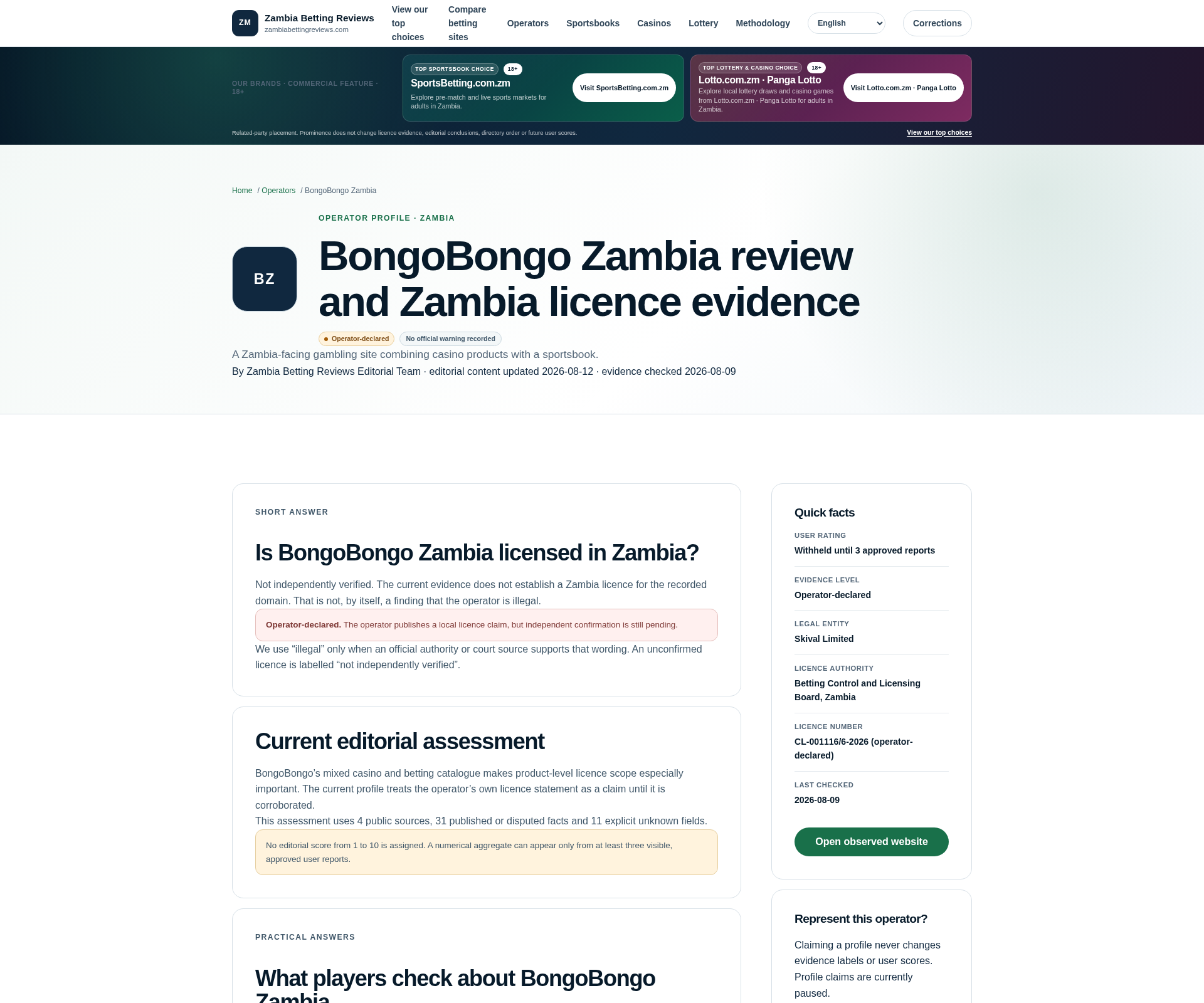
The supplied primary-site capture associates BongoBongo with bongobongo.co.zm, while the operator and licence details remain declarations rather than independently matched regulatory records. Skival Limited is the stated operator, and the stated licence is CL-001116/6-2026. No supplied primary record connects that entity, number and exact internet address in one current official entry. The resulting signal is amber: there is evidence to inspect, but important verification remains open.
| Review question | What the packet establishes | Position |
|---|---|---|
| Was a deposit tested? | No transaction evidence was supplied | Unknown |
| Was a withdrawal tested? | No withdrawal or settlement record was supplied | Unknown |
| Is an exact payment descriptor known? | No bank, mobile-money or card statement was supplied | Unknown |
| Is an operator named? | Skival Limited is declared as the operator | Operator statement only |
| Is a licence number shown? | CL-001116/6-2026 is operator-declared | Not independently matched |
| Overall evidence signal | Relevant records exist, but the decisive links remain open | Amber |
Payment audit: what can and cannot be verified
A useful payment audit follows money from the funding instruction to the final account statement. The packet contains no cashier capture, method list, minimum or maximum amount, processing time, fee schedule, transaction reference or named payment recipient. It would be unsafe to convert the mere existence of a public service into a claim that a particular bank, card or mobile-money method is available.
Before paying, record the exact internet address, amount, selected method, displayed recipient and any fee. After payment, retain the confirmation reference and compare it with the account balance and financial statement. A changed recipient name, a request to pay a private individual or instructions sent only through an informal message should pause the transaction. None of those warning conditions is alleged here; they are practical checks required because the packet does not identify the payment chain.
The same discipline applies to bonuses. No supplied record establishes a bonus value, wagering requirement, expiry period, eligible game or maximum conversion. A promotional balance should not be treated as withdrawable cash until its specific terms are available and understood. The payment-check process provides a neutral checklist for recording these details without assuming that an advertised method will work for every account.
| Payment checkpoint | Evidence to retain | Reason |
|---|---|---|
| Before deposit | Internet address, cashier screen, amount, recipient and fee | Confirms where the instruction originated |
| After deposit | Receipt, transaction reference and updated balance | Connects the transfer to the account credit |
| Before withdrawal | Available balance, rules, identity status and requested amount | Records the conditions shown at the time |
| After withdrawal | Request reference, status messages and statement entry | Distinguishes a pending request from settlement |
Exact internet address, entity and licence match
The primary-site capture shows public material associated with BongoBongo and bongobongo.co.zm. That is useful for identifying the address represented in the supplied evidence, but material published by the service cannot independently verify its own corporate or licensing declarations. The packet gives no separate official entry binding the exact address to Skival Limited and CL-001116/6-2026.
Three elements must match for a strong result: the precise internet address, the legal entity and the licence identifier. A record that names only an entity does not automatically cover every similarly named website. A number printed by a service is not independently verified merely because its format appears plausible. A current official register entry or direct written confirmation from the competent authority would be needed to close that gap.
The Ministry of Finance and National Planning lists the Betting Control and Licensing Board and Lotteries Control Board among its agencies. This establishes an institutional reference point, not a current registration for the service. The Betting Control Act establishes a Board and bookmaker-licensing framework, but the supplied text is not a live register connecting the named entity to the exact address. The Ministry of Tourism also publishes casino-licensing applications, guidance and an online checklist, yet that material is likewise not a current operator-and-address register.
| Match component | Supplied wording or record | Verification status |
|---|---|---|
| Public internet address | bongobongo.co.zm appears in primary-site material | Associated with the captured service |
| Legal entity | Skival Limited | Operator-declared |
| Licence | CL-001116/6-2026 | Operator-declared |
| Official exact-address match | No matching register entry supplied | Open |
| Expiry date | No date supplied | Unknown |
The correct conclusion is not that the declaration is false. It is that the packet cannot independently prove the complete three-part match. Readers can use the licence-check guide to structure a request that names all three elements rather than asking only whether the brand is known.

Is BongoBongo legitimate or a scam?
The supplied material does not support a definitive scam label. There is no official adverse finding, corroborated fraud record, verified payment loss or documented failed withdrawal in the packet. The third-party page provides discovery context only and cannot prove that a complaint is true, that funds are safe or that licensing is valid.
Nor does the material justify an unqualified legitimate verdict. The operator and licence wording have not been matched to the exact internet address through a current primary regulatory record, and no payment or withdrawal test exists. Amber accurately represents this middle position: relevant public material exists, but decisive financial and regulatory verification remains incomplete.
A scam assessment should focus on observable conduct. Warning signs include an altered internet address, payment to an unrelated personal recipient, requests for passwords or one-time codes, unexplained demands for repeated deposits, or refusal to provide a traceable complaint reference. These are screening criteria, not findings against this operator. If any appear, stop paying, preserve records and follow the scam-warning steps.
Is the service legal in Zambia?
The supplied law establishes a licensing framework, while the government records identify relevant institutions and licensing guidance. Those general records do not answer whether this precise internet address is currently authorised for every activity offered to a particular customer. No current official entry in the packet joins the address, Skival Limited, licence CL-001116/6-2026 and an expiry date.
For that reason, legality remains unresolved rather than negative. A service may make a licence declaration, but a legal conclusion requires a competent and current record covering the correct entity and activity. The absence of a supplied exact-address register is also not proof of illegality; it is an evidence limitation.
Users should distinguish operator licensing from their own obligations. Age restrictions, identity rules, account terms and applicable tax treatment may involve separate questions. None is established by the packet. The Zambia legal guide explains the distinction between a general framework and confirmation for a specific service. Anyone needing a binding interpretation should approach the competent authority or qualified local adviser rather than relying on promotional wording.
Withdrawals and the missing settlement trail
No withdrawal was conducted or documented. There is no request timestamp, pending status, rejection reason, reversal, completed transfer, statement entry or comparison between a promised and actual processing period. Consequently, no withdrawal speed, reliability rate or successful cash-out claim can be made.
A proper test begins before pressing the withdrawal button. Record the available cash balance separately from any promotional balance, the requested amount, the displayed method and all conditions shown. Save the confirmation reference and each status change. Settlement is established only when the funds appear in the destination account, not when an on-screen status says approved.
If a request is delayed, ask for the exact reason, the outstanding action, the applicable term and a traceable reference. Do not make another deposit merely because an unverified message says it is required to release funds. A legitimate request for tax, identity or account information should be checked against published terms and an authenticated support channel. This is general risk control, not evidence that such a demand has occurred here.
| Withdrawal question | Packet answer | What would resolve it |
|---|---|---|
| Which methods are supported? | Unknown | Dated cashier evidence |
| What limits apply? | Unknown | Account-specific terms or cashier capture |
| How long does settlement take? | Unknown | Timestamped request and statement entry |
| Was any request rejected? | No record supplied | Rejection notice with stated reason |
| Was a withdrawal completed? | No test supplied | Matching destination-account record |
KYC and the unresolved name mismatch risk
No supplied record describes the service's know-your-customer process, accepted documents, review period or rules for mismatched names. KYC performance therefore cannot be rated. The central practical risk is a mismatch among the account holder, identity document, telephone or mobile-money registration and payment account. Such a mismatch may complicate ownership checks or withdrawals, but the packet does not show that it has happened to any user.
Use the same legal name consistently and review spelling before depositing. Keep documents current, show only the information requested through an authenticated channel and never disclose a password, PIN or one-time code. If a document is rejected, request the precise reason and acceptable replacement rather than repeatedly uploading unrelated material.
A payment made from another person's account may create an additional source-of-funds or ownership question. Before using one, obtain written clarification through a verified support route. No evidence supplied here confirms whether third-party payments are accepted. KYC should also be completed early where possible; discovering an identity discrepancy only after requesting a withdrawal can make the evidence trail harder to reconstruct.
Complaints and escalation route
The packet contains no verified complaint outcome and no authenticated support address that can safely be reproduced. A complaint should therefore begin through the contact route displayed after independently reaching the captured internet address, not through a link received in an unsolicited message. Keep the issue factual and avoid combining several disputes into one vague allegation.
State the account identifier, transaction reference, amount, date, requested remedy and the deadline for a substantive response. Attach copies rather than surrendering original records. Ask for a complaint reference and retain every response. If the issue concerns a withdrawal, distinguish whether it is pending, rejected, reversed or marked as paid but absent from the destination account.
Escalation to an authority should include the exact internet address, declared entity, declared licence number and the full chronology. This allows the recipient to assess the same unresolved match identified here. The complaints guide provides a record structure, while urgent help is appropriate when financial harm or account compromise may be continuing. These routes do not guarantee recovery or a regulatory finding.
| Complaint record | Minimum detail |
|---|---|
| Identity of service | Exact internet address and account identifier |
| Money event | Amount, method, date and transaction reference |
| Disputed action | What occurred and what outcome was expected |
| Contact history | Dates, channels, replies and complaint reference |
| Requested remedy | A specific correction, explanation or payment outcome |
Clone and impersonation checks
Because no exact internet address was supplied as a separate structured field, the captured primary-site association is especially important. Type or verify bongobongo.co.zm carefully and compare every character. A copied design, familiar name or reused logo does not prove that another address belongs to the same operator.
Check the full address before entering credentials or payment details. Be alert to extra words, substituted letters, unusual subdomains and links shortened in messages. A secure connection protects traffic to the address shown; it does not by itself prove who controls the service or whether a licence applies.
Compare the payment recipient with the entity or payment information displayed in the authenticated account. If the recipient changes unexpectedly, pause and request an explanation through a separately verified channel. Never approve a mobile-money prompt whose amount or recipient differs from the instruction you initiated. Keep screenshots showing the full address and timestamp because cropped images can conceal the most important identifying detail.
The supplied logo is only an identification aid, and both captures are evidence snapshots rather than live guarantees. A clone may reproduce public artwork or wording. Exact-address checking must therefore come before visual familiarity.
Evidence chronology, limits and correction path
All five supplied records were checked on 22 August 2026. The primary government material establishes institutions, legislation and general casino-licensing guidance. The operator material associates the service with the captured internet address and contains self-declared information. The third-party capture is contextual only. These roles are not interchangeable.
| Evidence item | Role | What it supports | What it does not support |
|---|---|---|---|
| ZM-SRC-001 | Primary | Relevant boards are listed as government agencies | Current authorisation of the exact address |
| ZM-SRC-002 | Primary | A Board and bookmaker-licensing framework exist | A live operator register |
| ZM-SRC-005 | Primary | Casino application guidance and a checklist are published | Current registration of this service |
| ZM-SRC-021 | Operator | Public material is associated with the captured address | Independent verification of entity or licence |
| ZM-SRC-022 | User context | Third-party discovery context exists | Legality, safety or complaint truth |
The main missing records are a current official exact-address match, licence expiry, cashier evidence, transaction descriptors, withdrawal settlement, KYC rules and a verified complaint outcome. Any of these could materially change the assessment. A dated official entry connecting the address, Skival Limited and CL-001116/6-2026 could support a stronger licensing conclusion. An official adverse record or corroborated documented financial evidence could move the signal in the opposite direction.
Corrections should identify the disputed sentence and provide a dated, competent record through the contact route. Operator statements may clarify what the service claims, but they will remain labelled as operator evidence unless independently confirmed. The methodology explains why unknowns are preserved rather than filled with assumptions.
If, after completing these checks, you choose to proceed, use the single Use comparison route and verify the destination before entering details. Gambling can cause financial harm; set a firm limit and use responsible-gambling support if control is becoming difficult.
Frequently asked questions
Is BongoBongo licensed in Zambia?
The service declares Skival Limited and licence CL-001116/6-2026, but no supplied current primary record connects that entity and licence to the exact internet address. The licence claim is therefore not independently verified.
Is BongoBongo a scam?
The packet contains no official adverse finding or corroborated fraud evidence, so a scam label is not supported. An unconditional safety verdict is also unsupported because the exact licensing match and payment performance remain open.
Was a BongoBongo withdrawal tested?
No. The packet includes no withdrawal request, status history, settlement time or destination-account entry. Withdrawal speed and reliability are unknown.
Which payment methods does BongoBongo accept?
No verified cashier or payment-method record was supplied. Specific banks, cards, mobile-money services, limits and fees should not be assumed.
What should I do if my identity details do not match my payment account?
Pause before depositing or withdrawing and request written clarification through an authenticated support channel. Keep the reply and do not disclose passwords, PINs or one-time codes.
How can I complain about a payment or withdrawal?
Record the exact internet address, account identifier, amount, date, transaction reference, contact history and requested remedy. Ask for a complaint reference, then use the documented escalation route if the operator does not resolve the issue.