Castlebet Zambia: licence, products and evidence review
Castlebet is associated in the supplied material with a Zambia-focused discovery record, but the evidence does not identify an exact internet domain, independently confirm the legal entity operating the service, or connect that entity to a current licence. The resulting signal is amber: the available records justify caution and further verification, not a conclusion that the service is fraudulent or fully verified.
A useful assessment must also keep three product categories separate. Sportsbook, casino and lottery activities may fall within different legal or administrative boundaries. Evidence that addresses one category cannot automatically prove authorisation for the others.

Verdict at a glance
| Question | Evidence-led answer | Confidence |
|---|---|---|
| Is the exact internet domain verified? | No exact domain was supplied or established by a primary record. | Low |
| Is the operating legal entity confirmed? | No. The operator remains independently unconfirmed. | Low |
| Is a current licence confirmed? | No licence number, holder or expiry date was established. | Low |
| Is the service proven to be a scam? | No. The packet contains no official adverse finding or corroborated documented misconduct. | Low |
| Is it proven legal for all offered products? | No. Product-specific authorisation and the domain-to-entity link remain open. | Low |
The amber assessment reflects open evidence rather than a negative official decision. Zambia has identifiable public bodies and statutory frameworks relevant to betting, lotteries and casino licensing, but the supplied primary records do not list Castlebet, an exact domain, a licence number or a licence holder. A third-party discovery record provides context only and cannot close those gaps.
Do not treat a familiar name, logo, local payment option or Zambia-focused promotion as equivalent to regulatory confirmation. Before depositing, a user should establish the exact address being visited, the company named in the contractual terms, the product being offered and the licence claimed for that product.
Casino, sportsbook and lottery boundaries
The service name alone does not show whether a user is dealing with a bookmaker, an online casino, a lottery product or a combined platform. That distinction matters because a licence or application concerning one activity does not necessarily cover every other activity displayed through the same interface.
The Ministry of Finance and National Planning identifies the Betting Control and Licensing Board and the Lotteries Control Board among its agencies. That confirms an institutional distinction between betting and lottery oversight, but it does not identify a licensed internet address for this service. Separately, the Ministry of Tourism publishes casino-licensing application material and a checklist. Those materials show that casino licensing has its own administrative requirements; they are not a current register connecting a particular operator to a domain.
| Product encountered | Evidence needed before relying on a licence claim | Unresolved point here |
|---|---|---|
| Sportsbook or bookmaker service | Current bookmaker licence, named holder and a reliable connection to the exact domain | No holder, number or domain match supplied |
| Casino games | Current casino authorisation covering the relevant activity and operator | No casino authorisation supplied |
| Lottery or draw product | Applicable lottery authority record and named authorised entity | No product-specific record supplied |
Users should therefore inspect each product boundary separately. If a site displays sports odds and casino games, evidence for bookmaker licensing should not be stretched into proof that casino games are authorised. Likewise, a lottery-related approval would not by itself establish permission to accept sportsbook wagers.
Exact domain, operator and licence match
A strong verification chain has four connected parts: the exact domain, the legal entity controlling it, the licence holder and the authorised product scope. None should be substituted with a similar trading name. In the supplied packet, the exact domain field is empty, the operator is not independently confirmed and no licence or expiry date is available.
| Verification element | What was established | What remains necessary |
|---|---|---|
| Exact internet address | Nothing conclusive | Full domain and any payment or sign-in subdomains |
| Legal operator | Not independently confirmed | Registered company name and identifying details |
| Licence | Not independently confirmed | Number, holder, status and effective dates |
| Product scope | Betting, casino and lottery frameworks exist generally | Proof covering the particular products offered |
| Domain-to-entity connection | No primary match | Regulator record or another reliable primary connection |
The practical check begins in the browser address bar, not with a search result or promotional message. Record the complete domain, including spelling and country suffix. Compare it with the address stated in the service’s terms, privacy notice and deposit instructions. Then compare the named company in those documents with the licence holder claimed by the service.
A mismatch is not automatically proof of fraud; companies may use trading names or service providers. It is nevertheless a reason to pause until the relationship is documented. Material differences in company names, unexplained redirects, or payment instructions naming an unrelated recipient are more significant than cosmetic differences in page design.
What the Zambian primary records establish
The public records support only a limited institutional and legal picture. The Ministry agency listing identifies the Betting Control and Licensing Board and Lotteries Control Board. It does not provide a current register matching this service to a domain or legal entity.
The Betting Control Act establishes a Board and a bookmaker licensing framework. The supplied Act does not function as a current online register, so its existence cannot establish that a particular trading name or internet address holds a valid licence today.
The casino-licensing guidance and checklist published by the Ministry of Tourism concerns casino-licensing applications. It explains an administrative route but does not confirm that this operator completed that route or holds current authority.
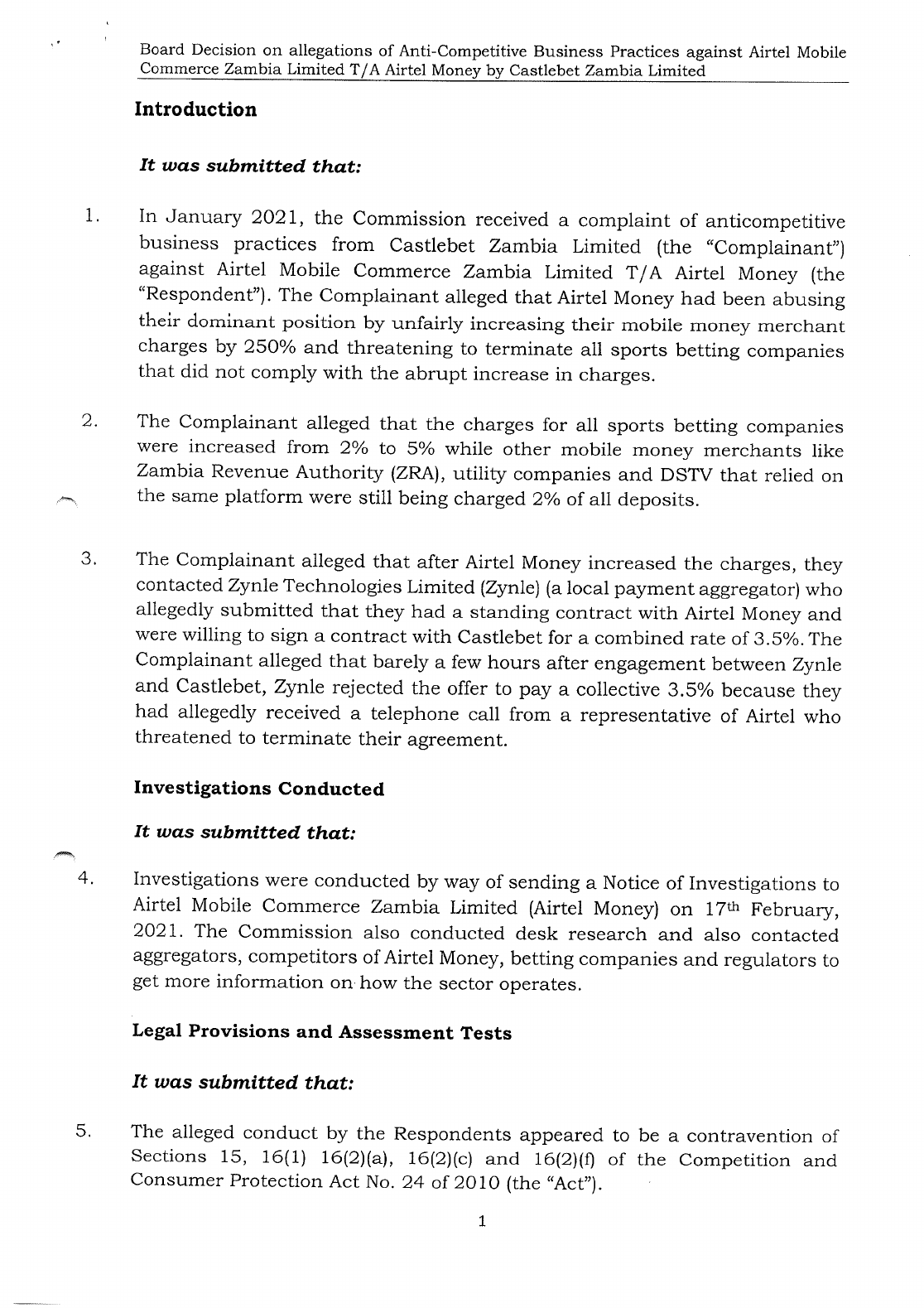
That capture must not be mistaken for a licensing record. Its supplied address concerns an Airtel Money board decision, and the packet contains no claim establishing that it identifies the reviewed service. It therefore adds no positive or adverse weight to the licence verdict.
Scam or legitimate: what can actually be concluded
The evidence does not support calling the service a scam. There is no official adverse record, adjudicated complaint, enforcement decision or corroborated documented pattern of misconduct in the packet. Making a fraud finding from an unverified domain or missing licence match would go beyond the evidence.
The opposite conclusion is also unsupported. A legitimate verdict would require a reliable chain from the exact domain to a named legal operator and current, product-appropriate authorisation. That chain is absent. The correct position is an open-evidence warning: identity and regulatory status require confirmation before money or identity documents are submitted.
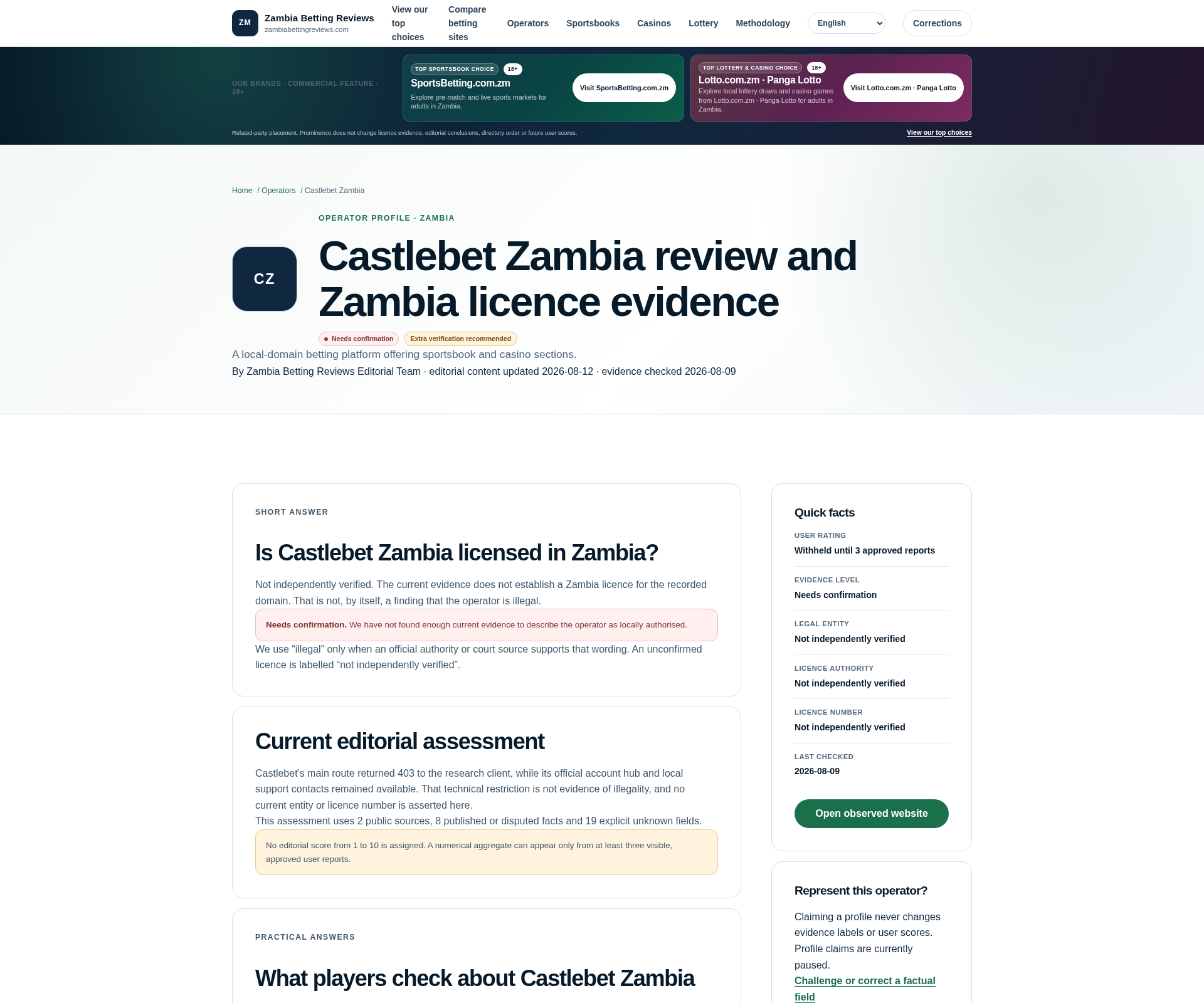
A dated third-party page mentions Castlebet in a Zambia context. It is useful for discovering that the name has circulated publicly, but it is not a regulator record. It cannot prove legality, safety, payment performance, ownership or the truth of any complaint.
Users comparing warning signs can consult the internal scam-warning checklist. The most important distinction is between absence of proof and proof of wrongdoing. Here, the former is documented; the latter is not.
Payments, deposits and transaction records
No supported evidence identifies deposit methods, currencies, fees, processing times or payment partners for this service. In particular, the supplied Airtel Money-related capture cannot be used to claim that Airtel Money is offered, approved or connected to the operator. Payment logos displayed by a site would also need independent confirmation before being treated as evidence of a commercial relationship.
Before depositing, retain a transaction record that can later connect the payment to the account and recipient. It should show the date, amount, transaction reference, recipient descriptor and status. Screenshots can preserve context, but an official wallet or bank record is stronger than an image of a cashier screen.
| Stage | Record to retain | Reason |
|---|---|---|
| Before payment | Exact domain, account identifier, displayed recipient and applicable terms | Establishes where the transaction was initiated |
| Deposit | Provider receipt, amount, time and reference | Supports tracing and reconciliation |
| Balance credit | Account ledger entry and any bonus conditions | Shows whether funds were credited as cash or restricted value |
| Withdrawal request | Amount, destination, status and timestamp | Creates a dated record of the request |
| Failure or reversal | Error message and provider response | Helps distinguish operator, bank and wallet issues |
Check whether the recipient name reasonably corresponds with the disclosed operator or an explained payment processor. Do not send money to a personal number merely because a message uses the brand name. If payment instructions change after contact through social media or messaging applications, return to the independently verified domain rather than following the new instructions.
The internal payment-check process provides a structured way to compare recipient details, transaction references and account records. It does not replace confirmation of the operator or licence.
Withdrawals and identity verification
No withdrawal test was supplied. There is no verified evidence about minimum or maximum withdrawals, pending periods, rejection rates, fees, document-review times or successful payouts. Claims that withdrawals are fast, slow, reliable or routinely blocked would all be unsupported.
Before committing funds, read the withdrawal and identity-verification rules attached to the exact service. Important terms include whether withdrawals must return to the original funding method, whether a turnover requirement applies, which documents may be requested, and what happens when the name on the payment account differs from the gambling account.
Identity verification can be a legitimate compliance control, but the request must come through a verified channel. A user should confirm the domain before uploading a National Registration Card, passport, proof of address or payment record. Documents should not be sent to an unverified messaging account or an address discovered only through an unsolicited message.
Keep an ordered record of every request and response. If a withdrawal is delayed, ask for the specific contractual or verification reason, the outstanding document, and a reference number. Avoid creating multiple accounts or repeatedly cancelling a pending withdrawal, because those actions may complicate the factual record.
The absence of a documented payout test is a material limitation, not proof of non-payment. Until transaction evidence exists, the most defensible risk control is to avoid depositing more than can be lost and to test withdrawal functionality with a modest amount only after identity, domain and licence checks are complete.
Complaints and escalation route
No supported complaint record establishes wrongdoing by Castlebet. The packet contains no operator response, regulator ruling, court decision or verified transaction file. Any complaint encountered elsewhere should therefore be treated as an allegation until its account details, dates, terms and outcome can be checked.
A useful complaint starts with a compact chronology. Include the exact domain used, account identifier, transaction references, amounts, relevant terms, withdrawal status and copies of correspondence. State the remedy requested, such as account correction, explanation, payment review or return of an unauthorised transaction. Do not publish identity documents or full financial credentials.
| Escalation step | Action | Evidence to attach |
|---|---|---|
| Operator support | Request a written case number and reasoned response | Account ledger, transaction references and relevant terms |
| Payment provider | Query the payment status or recipient where appropriate | Official receipt and recipient descriptor |
| Relevant authority | Ask which body covers the specific product and licence claim | Domain, legal entity claim, product type and prior correspondence |
| Independent record | Preserve the complete chronology | Dated files with sensitive details redacted |
Because product boundaries matter, a betting dispute, casino-licensing question and lottery complaint may not follow the same route. Confirm the responsible body rather than assuming that one agency covers every activity. The internal complaints guide explains how to organise evidence without presenting an allegation as an established fact.
For loss of control, distress or immediate gambling harm, stop depositing and use responsible-gambling support or urgent help. Those routes are separate from deciding whether a commercial dispute is legally valid.
Clone and impersonation checks
An unconfirmed exact domain creates a particular impersonation risk. A copied logo or familiar colour scheme can be reproduced without proving control by the genuine operator. Search advertisements, shortened links, social profiles and direct messages can also lead to addresses that differ by one character.
Write down the full domain rather than relying on its appearance in a mobile browser. Check for substituted letters, extra hyphens, unexpected subdomains and redirects to a different address at sign-in or payment. Encryption protects data in transit but does not establish that the recipient is licensed or genuine, so a padlock is not enough.
Compare the legal name across the terms, privacy notice, account footer and payment instructions. A consistent name is useful but still requires primary confirmation. Be cautious where the terms omit a company, claim a licence without a number, or reference a jurisdiction unrelated to the Zambian product being promoted.
Never use the supplied logo as an authenticity test. It is an identification asset only. Likewise, the independent capture shows that a third party used the name, not that the pictured interface, any linked address or any person contacting a user is authentic.
If the domain cannot be matched to an operator and current product-specific licence, do not submit identity documents or make a payment. The only commercial route supplied for this dossier is Compare records; it should be used only after completing those checks.
Evidence chronology, methodology and correction path
The evidence packet was checked on 22 August 2026. On that date, the Ministry agency listing supported the existence of the Betting Control and Licensing Board and Lotteries Control Board. The Betting Control Act supported the existence of a Board and bookmaker licensing framework. Ministry of Tourism material supported the availability of casino-licensing applications, guidance and a checklist. None supplied a current domain register or a Castlebet-specific licence match.
The third-party record was also checked on 22 August 2026. Its role is limited to discovery context. It was not promoted to primary evidence, and no legal, safety or complaint conclusion was drawn from it. The Airtel Money-related capture was kept within its actual boundary: no supplied claim links it to this operator.
The assessment method gives greatest weight to current primary records that precisely identify the domain, entity, licence and product. Operator statements can describe claimed terms but do not independently validate themselves. Third-party user context can identify questions worth investigating but cannot establish regulatory status or complaint truth without corroboration.
This produces an amber signal based on open evidence. It can change if a current regulator record identifies the exact domain, legal operator, licence number, status and authorised products. An official adverse decision or corroborated documented evidence could also change the assessment in the other direction.
Corrections should include the precise disputed statement and a source that can be dated and verified. Suitable material may include a current regulator entry, licence document whose holder and scope can be authenticated, company record, official decision or complete transaction chronology. Submit such material through contact. The methodology and editorial policy explain how evidence tiers and corrections are handled.
Frequently asked questions
Is Castlebet licensed in Zambia?
A current Castlebet licence was not independently confirmed. The supplied primary records establish general betting, lottery and casino-licensing structures, but they do not connect an exact domain or named legal operator to a current licence.
Is Castlebet legal in Zambia?
The evidence is insufficient for a definitive legal conclusion. Legality depends on the exact service, operating entity, product type and current authorisation. Those links remain unverified in the supplied records.
Is Castlebet a scam?
No supplied record proves fraud or supports a red warning. However, the exact domain, operator and licence are also unconfirmed, so the amber signal calls for verification before depositing or sharing identity documents.
Which payments and withdrawals does Castlebet support?
No payment method, withdrawal channel, fee, limit or processing time was verified. The Airtel Money-related capture does not establish that Airtel Money is offered by or connected to the service.
Has a Castlebet withdrawal been tested?
No withdrawal test or verified payout record was supplied. There is therefore no evidence-led basis for claiming that payouts are fast, slow, reliable or routinely rejected.
How can I verify the genuine Castlebet domain?
Record the full browser address, check it against the legal terms and privacy notice, identify the operating company, and seek a current primary record connecting that entity and exact domain to the relevant product licence. A logo or padlock alone is not proof.