Mojabet Zambia: licence, operator and risk checks
An advert, message or social post may be the first step towards a betting service, but the address opened after the tap is the detail that matters. For Mojabet, the supplied evidence identifies an operator-declared company and licence number, yet it does not identify a verified official domain. That break in the advert-to-address trail prevents a green assessment.
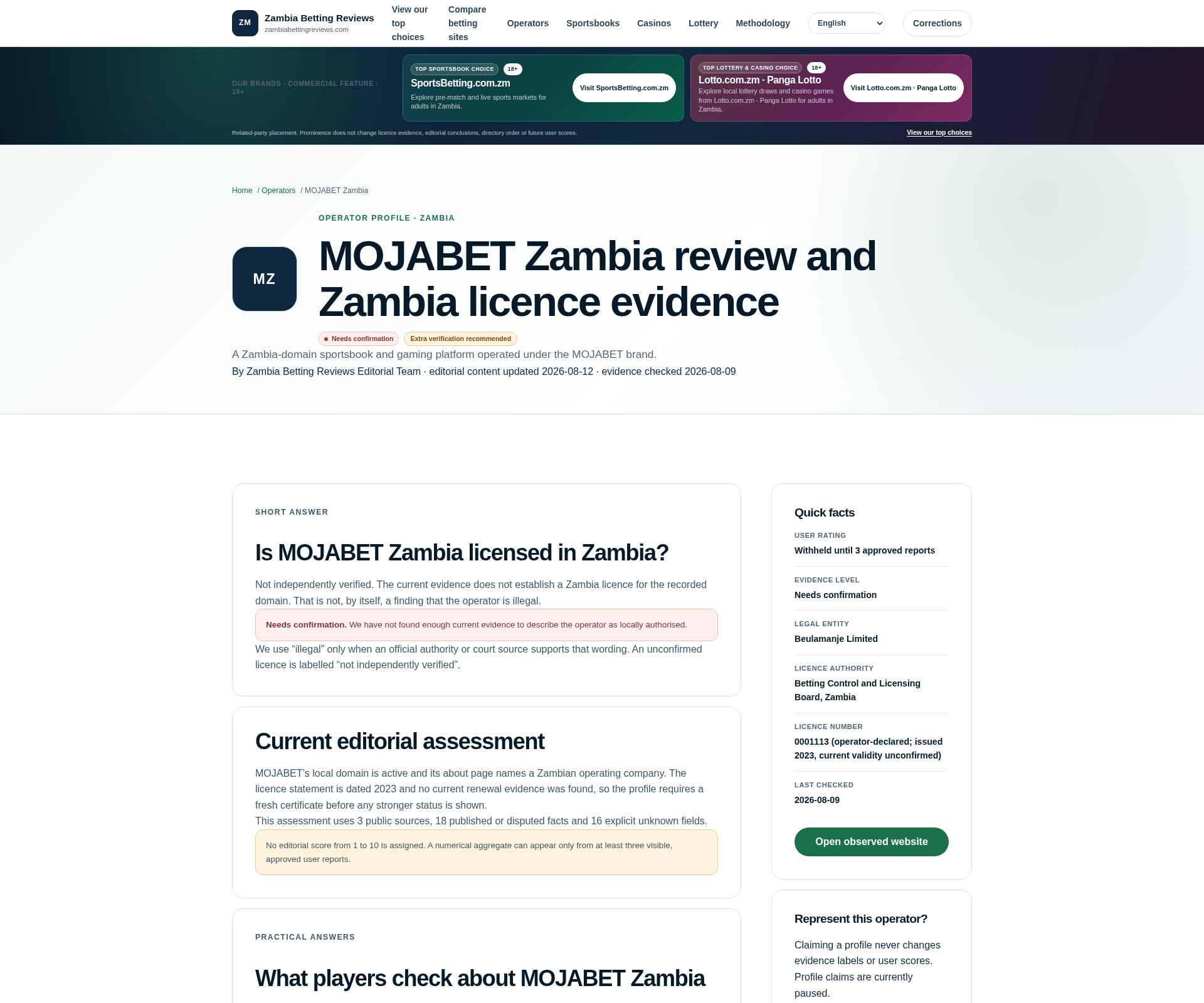
The current signal is amber. Beulamanje Limited is named on an operator page, which also states licence number 0001113 and an issue date of 16 August 2023. Those details are operator declarations, not a regulator-register match in the accepted packet. The primary records explain Zambia’s betting framework and identify relevant public bodies, but none provides a current register connecting the company, licence and exact internet address.

Verdict at a glance
The evidence does not establish that the service is a scam. It also does not establish, through a current primary record, that an unspecified address belongs to a licensed Zambian operator. “Legitimate” and “legal” therefore cannot be treated as proven conclusions.
| Question | Supported finding | Practical meaning |
|---|---|---|
| Who is named as operator? | Beulamanje Limited is named on the operator page. | Treat the name as operator-declared until it is matched to a primary record. |
| What licence is stated? | Number 0001113, stated as issued on 16 August 2023. | The number and date require independent confirmation. |
| Which domain is verified? | None in the supplied packet. | Do not assume an advert, application or search result opens an official address. |
| Is legality established? | No current company-licence-domain match was supplied. | The legal status of the precise online service remains open. |
| Is there proof of fraud? | No official adverse record or corroborated evidence was supplied. | An amber signal is appropriate; a red scam label is not supported. |
The most important missing link is the exact internet address. A licence number on a service-controlled screen cannot, by itself, prove that the address displaying it is covered by that licence. The operator name, licence number and domain must be checked as one chain.
From an advert to the actual address
A mobile advert can pass through several redirects before reaching a registration screen. Record the full destination after every redirect rather than relying on the wording, colours or icon in the advert. The accepted evidence contains no advert capture and no verified official hostname, so no particular destination can be endorsed.
Use a cautious acquisition check:
- Copy the final address without signing in or depositing.
- Note every hostname used during registration, account access, payments and support.
- Compare the company name and licence statement across the footer, terms and account screens.
- Stop if the company changes, the licence number disappears or payment is requested through an unrelated person.
- Preserve screenshots showing the address bar, date and relevant statement.
A familiar brand mark is weak identity evidence because it can be copied. A shortened link is also insufficient because its final destination is hidden until opened. An application package name does not prove ownership unless it can be connected to the same legal entity and official address.
Hostname, company and licence match
Three separate identifiers need to align: the exact hostname, the legal operator and the current licence. The packet supports only an operator-page statement about the latter two. It supplies no exact domain and no current primary entry confirming licence 0001113 for Beulamanje Limited.
| Identity layer | Evidence available | Status |
|---|---|---|
| Exact hostname | The exact-domain field is blank. | Unverified |
| Legal company | Beulamanje Limited appears on an operator page. | Operator-declared |
| Licence number | 0001113 appears on the operator page. | Operator-declared |
| Stated issue date | 16 August 2023 appears on the operator page. | Operator-declared |
| Expiry or present validity | No expiry or current-status record was supplied. | Unknown |
| Primary three-way match | No accepted record joins the hostname, company and licence. | Not established |
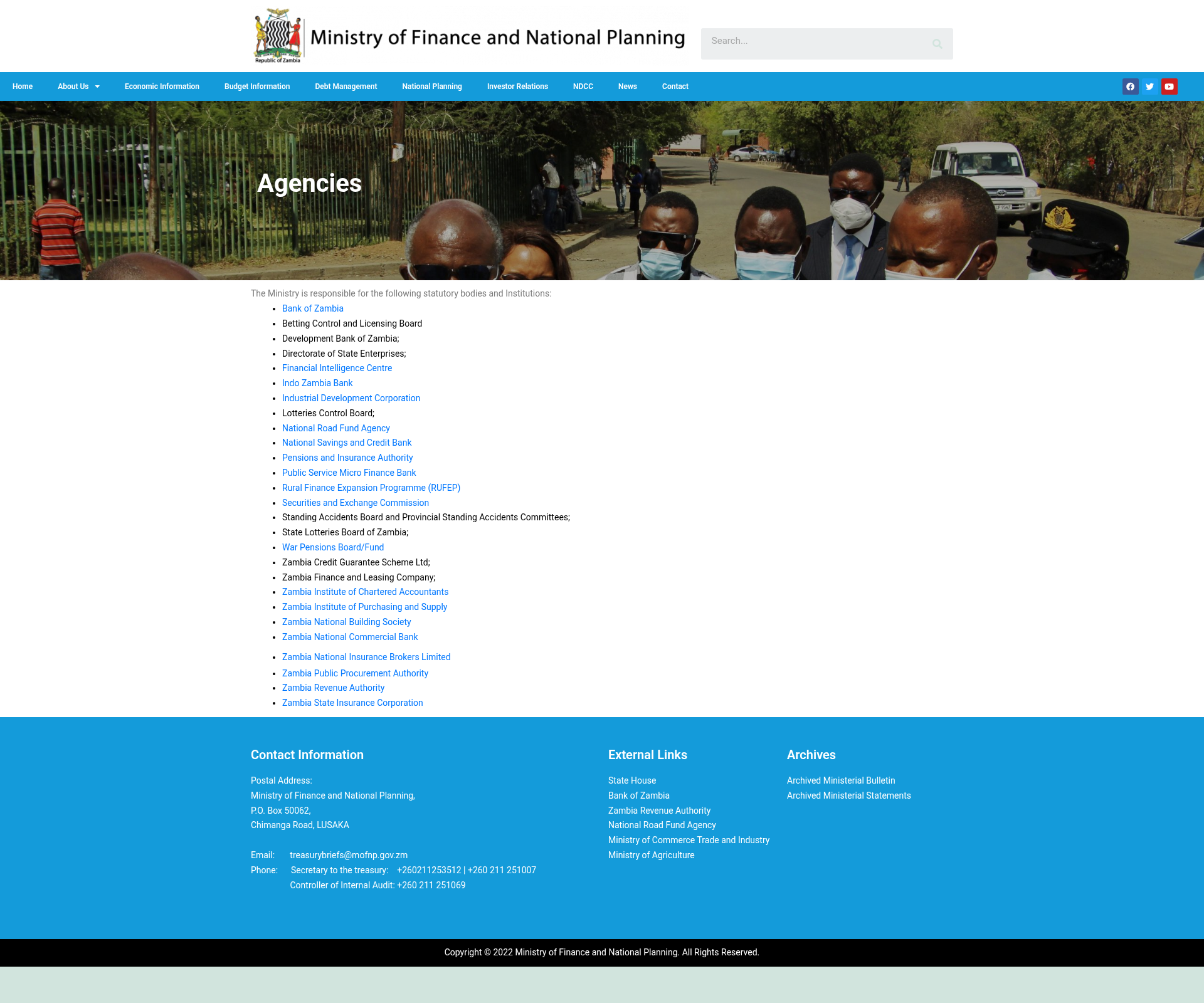
The Ministry of Finance and National Planning agencies listing names the Betting Control and Licensing Board and Lotteries Control Board among its agencies. This establishes institutional context, not approval of this service. The Betting Control Act establishes a Board and a bookmaker-licensing framework, but the supplied Act does not contain a current domain register. The Ministry of Tourism casino-licensing guidance publishes application material and an online checklist; it is not a current operator-domain register either.
These sources should not be combined into a conclusion they do not state. A legal framework can exist while the status of a particular digital service remains unverified.
Legal in Zambia or not?
The primary sources confirm that Zambia has public bodies and legislation relevant to betting or casino licensing. They do not answer whether the precise service reached from a mobile advert is currently authorised. No accepted record confirms the exact domain, present licence validity, licence scope or expiry date.
The responsible conclusion is therefore narrower than “legal” or “illegal.” The service presents an operator name and licence claim, but the supplied primary material does not independently match those details. Equally, there is no official adverse decision in the packet establishing unlawful operation.
For a stronger legal check, request a record that clearly shows all of the following:
| Required field | Why it matters | Current position |
|---|---|---|
| Licensed legal entity | Connects the consumer-facing service to a company. | Only operator-declared |
| Licence number and category | Shows which activity is purportedly authorised. | Number stated; category not supplied |
| Current validity or expiry | Prevents reliance on a historical issue date. | Not supplied |
| Approved domain or digital channel | Connects the licence to the address used. | Not supplied |
| Issuing authority record | Provides independent confirmation. | No entity-specific record supplied |
Consult the licence-checking guide and the explanation of gambling legality in Zambia before treating the licence wording as conclusive. If a competent authority later confirms or rejects the company-domain match, the signal can be revised.
Payments, application access and browser use
No accepted record identifies supported deposit methods, currencies, processing companies, minimum deposits, fees, reversals or payment times. There is also no evidence establishing whether the service uses a verified application, a browser-only flow or both. Any payment logo shown during registration should be treated as a claim until the payment provider and recipient are confirmed.
Before depositing, compare the recipient displayed by the bank, mobile-money service or card confirmation screen with Beulamanje Limited. A different recipient is not automatically proof of fraud because processors may be used, but the relationship should be explained in the terms or by support. Do not proceed when payment is requested to a private individual, when the recipient changes without explanation, or when support asks for a one-time password or account PIN.
Make the smallest reasonable test only after identity checks are complete. Save the cashier screen, transaction reference, amount, time, recipient and balance change. Avoid sending repeated payments merely because the first one remains pending. The payment checks set out a record-keeping process for deposits and reversals.
The packet does not support claims of fast deposits, reliable mobile-money access, free transactions or secure application distribution. Those points remain unknown rather than negative. The absence of evidence should not be converted into either praise or accusation.
Withdrawals and identity checks
No withdrawal test was supplied. There is no verified information about withdrawal methods, minimum amounts, maximum limits, processing times, fees, pending periods or cancellation controls. There is also no accepted evidence describing the service’s identity-verification requirements.
Before staking meaningful funds, obtain and save the withdrawal rules visible on the exact address being used. Check whether withdrawals must return through the deposit method, whether bonus conditions restrict access to the balance, and whether identity documents are required before a request can be approved. Record the rules before accepting a promotion because later screenshots cannot prove what was displayed at registration.
Identity checks can be part of account and regulatory controls, but document collection creates privacy risk when the recipient is uncertain. Confirm the company identity, privacy notice, upload destination and support channel before sending an identity card, selfie, bank statement or address document. Do not send documents through an unrelated messaging account merely because someone uses the brand name.
A practical withdrawal test should record the request time, amount, displayed status, messages received and settlement time. One successful test would describe only that transaction; it would not prove that every account or later request will have the same result. In this dossier, no successful or failed withdrawal experience is claimed.
Complaints and escalation records
The accepted packet contains no verified complaint outcome involving this operator. A dated third-party discovery page exists, but it is contextual material only. It does not prove that a complaint is true, that a licence is valid, or that the service is safe or unsafe.
Start a complaint with a concise chronology: account identifier, exact hostname, transaction references, dates, amounts, disputed rule and requested remedy. Remove unnecessary identity data from general correspondence. Keep originals of payment receipts and screenshots, and preserve full messages rather than cropped fragments that remove dates or sender details.
If support does not resolve the matter, use the complaints route to organise the evidence and identify an appropriate escalation path. A regulator or payment-provider complaint should distinguish observed facts from conclusions. For example, “withdrawal requested on a stated date and still shown as pending on another stated date” is stronger than an unsupported accusation of theft.
Urgent signs such as demands for additional deposits to release funds, requests for passwords, or threats involving identity documents warrant stopping contact and securing payment and communication accounts. The scam-warning checklist explains immediate preservation steps.
Clone and impersonation checks
Because no official hostname is established, clone risk deserves special attention. A copied logo, similar spelling or polished mobile screen cannot prove that a site is operated by the declared company. Treat every address as unverified until it can be matched to an authoritative record or a confirmed company channel.
Check the hostname character by character. Look for substituted letters, extra words, unusual subdomains and redirects to a different address at payment or sign-in. The connection padlock indicates encryption to the displayed address; it does not establish that the address belongs to the licensed operator.
Also compare the legal name in the terms with the payment recipient and privacy notice. Save evidence before contacting support because content can change. Never install an application file sent by an unknown account, disable device protections, or grant remote access for “verification.” No supplied evidence identifies an official application package, so none can be recommended.
Risks, unknowns and safe limits
The amber signal reflects open evidence, not a finding of misconduct. The main risk is identity uncertainty: an operator and licence are stated, but the exact address and current licence status are not independently joined to them. Payment, withdrawal and identity-check terms are also unsupported by the packet.
Key unknowns include licence expiry, licence category, official hostname, payment methods, withdrawal performance, account-verification rules, complaint handling and application provenance. These gaps matter because each affects whether a consumer can identify the responsible entity and recover records if a dispute occurs.
Do not gamble with money needed for rent, food, transport, school costs or debt payments. Set a loss limit before depositing and do not increase it to recover earlier losses. If play feels difficult to control, stop transactions and use responsible-gambling support or urgent help. Identity verification and a valid licence, even if later confirmed, would not remove the financial risks of gambling.
Evidence chronology and assessment method
On 22 August 2026, the accepted packet recorded three primary sources and one third-party contextual source. The ministry agencies page supplied institutional context. The Betting Control Act supplied the statutory framework. The tourism ministry material supplied casino-application guidance. None supplied a current entry matching the operator, licence and domain.
The third-party page was retained only as discovery context. It was not used to determine legality, safety, complaint truth or licence validity. The operator-page company, licence number and issue date were treated as declarations because no accepted primary record independently confirmed them.
The method gives greater weight to current primary records than to operator statements or user material. Green requires current primary evidence for the precise entity and domain. Red requires an official adverse record or corroborated documented evidence. With neither threshold met, amber is the proportionate result. More detail on source handling appears in the assessment methodology.
A correction can be considered through the contact route. Useful material would include a dated regulator entry, licence document whose authenticity can be checked, current-status confirmation, approved-domain record, or a complete transaction chronology. A logo, undated screenshot or repeated marketing claim would not resolve the central identity gap.
Frequently asked questions
Is Mojabet legal in Zambia?
The supplied primary sources establish a Zambian betting-licensing framework, but they do not match an exact Mojabet domain to Beulamanje Limited and licence 0001113. Current legality for the precise online service is therefore not established by this packet.
Is Mojabet a scam?
No official adverse record or corroborated evidence in the packet establishes fraud. However, the missing official domain and current licence match leave material uncertainty, so the signal is amber rather than green.
Who operates Mojabet?
The operator page names Beulamanje Limited. This is an operator declaration and was not independently confirmed by an entity-specific primary record in the supplied evidence.
What licence number does Mojabet state?
The operator page states licence number 0001113 and says it was issued on 16 August 2023. No expiry date, current-status confirmation, licence category or approved-domain record was supplied.
Which Mojabet website is official?
No exact domain was supplied or verified. Record the final hostname reached from any advert, check redirects, and do not rely on a logo, spelling similarity or connection padlock as proof of ownership.
Are Mojabet withdrawals reliable?
No withdrawal test or verified processing data was supplied. Methods, limits, fees, processing times and identity requirements remain unknown, so no reliability claim can be made.