Betika Zambia: licence, domain and safety evidence
Start with the address, not the colours, name or logo. A convincing lookalike can reproduce familiar branding while sending deposits or identity documents to an unrelated recipient. The verified packet does not identify an exact official domain for Betika in Zambia. That missing link prevents a green finding, even though the supplied operator declaration names Shade Bet Limited and quotes licence 0000938 / CL-000023/1-2024.
The evidence signal is therefore amber. It does not mean that fraud has been established. It means the available primary records explain Zambia’s licensing framework and responsible bodies but do not connect a precise internet address, the named company and the declared licence in one current regulator entry.

The lookalike-domain test comes first
Before entering a telephone number, password, one-time code, identity document or payment detail, inspect the full address shown by the browser. Do not rely on a search-result headline, social-media button, forwarded message or familiar-looking logo. The decisive question is whether the exact domain can be tied to Shade Bet Limited through a current competent record or another authoritative channel.
That tie is absent from the packet. The exact-domain field is blank, and none of the three primary sources supplies a current operator-domain register. Consequently, no domain should be treated as verified merely because it contains the name Betika. Extra words, substituted letters, unusual hyphens, misleading subdomains and an unexpected country ending are all reasons to stop.
| Address check | What to inspect | Safe response |
|---|---|---|
| Exact spelling | Every letter in the registrable domain, not just the page heading | Stop if the spelling differs from an independently confirmed address |
| Subdomain structure | The part immediately before the registrable domain may be decorative or deceptive | Read the address from right to left before signing in |
| Secure connection | A valid encrypted connection protects transit but does not prove licensing or ownership | Treat the padlock as a technical minimum, not an approval seal |
| Redirect destination | The final address after opening a link | Do not continue if an unexplained redirect changes the domain |
| Payment recipient | Name shown by the bank, wallet or payment prompt | Do not pay when the recipient cannot be reconciled with the operator |
A clone may also copy support wording and licence numbers. Quoting a real-looking number is not enough: the number, legal entity, service and exact domain must match. Use the dedicated licence checks and scam warnings guidance before exposing an account or payment credential.
What the records establish—and what they do not
The Ministry of Finance and National Planning lists the Betting Control and Licensing Board and Lotteries Control Board among its agencies. This is useful institutional evidence, but the cited page does not establish that a particular domain is registered to this service.
The Betting Control Act establishes a Board and a bookmaker licensing framework. It supports the conclusion that bookmaker activity sits within a statutory licensing structure. It does not provide a current internet-domain register and does not, by itself, authenticate the supplied operator declaration.
The Ministry of Tourism publishes casino-licensing applications, guidance and an online checklist. That material concerns casino licensing, but the cited page is not a current list matching online operators to domains. It should not be stretched into proof of this service’s legality.
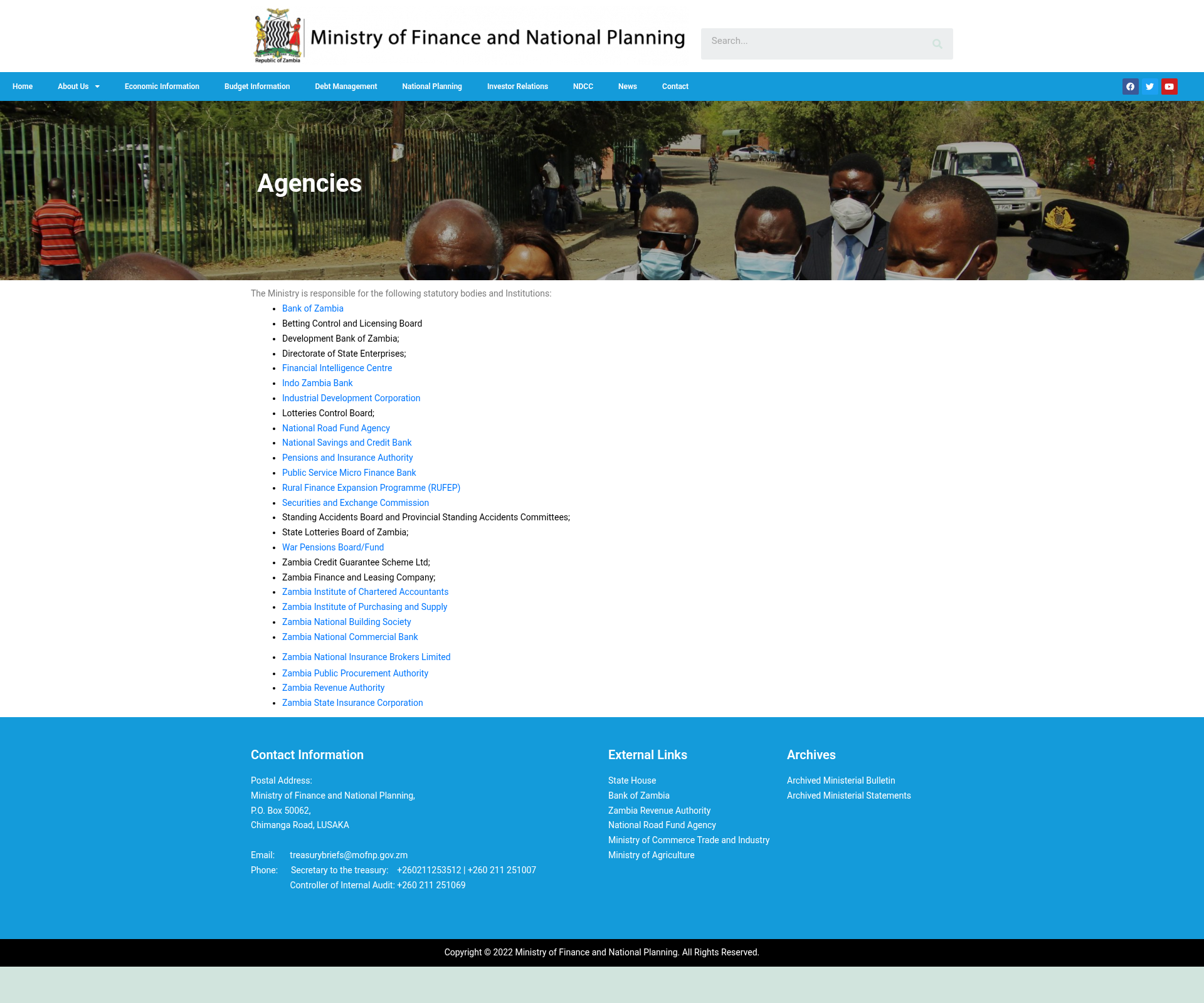
| Evidence item | Supported conclusion | Unsupported conclusion |
|---|---|---|
| Ministry agency listing | Relevant betting and lotteries control bodies are listed among government agencies | A particular website is approved |
| Betting Control Act | Zambia has a Board and bookmaker licensing framework | Licence 0000938 / CL-000023/1-2024 is current or belongs to a stated domain |
| Casino-licensing guidance | Application guidance and a checklist are published | The service is registered as an online casino |
| Supplied operator declaration | Shade Bet Limited and the stated number are claimed in the packet | Independent confirmation, expiry status or domain ownership |
The legal position is therefore unresolved at the domain level. Zambia has a licensing framework, but framework evidence is not operator verification.
Operator and licence matching
The supplied declaration names Shade Bet Limited and gives 0000938 / CL-000023/1-2024 as the licence reference. No expiry date is supplied. More importantly, none of the accepted primary records in the packet names that company, quotes that number or identifies an exact web address for it.
A complete match would contain four aligned elements: the legal company name, licence number, current status or validity period, and exact domain. Here, only the operator-facing declaration provides the first two. The current status, expiry and domain relationship remain open.
| Matching element | Packet value | Verification position |
|---|---|---|
| Trading name | Betika | Supplied identity; not sufficient on its own |
| Declared legal entity | Shade Bet Limited | Not confirmed by the cited primary records |
| Declared licence | 0000938 / CL-000023/1-2024 | Operator-declared; current status not independently established |
| Expiry date | Not supplied | Unknown |
| Exact Zambian domain | Not supplied | Unknown and material to the assessment |
This is why the signal cannot be green. It is also why a red finding would overstate the packet: there is no official adverse record or corroborated documented evidence establishing misconduct. Amber accurately reflects an open verification gap.
Is it legitimate, and is it legal in Zambia?
No definitive “legitimate” or “scam” conclusion follows from these records. The packet contains no official warning against the operator, no verified fraud finding and no corroborated complaint outcome. It also lacks the current primary entry needed to confirm the declared licence against the exact service address.
Likewise, legality cannot be decided from a familiar name or from the existence of betting legislation alone. The legislation shows that licensing matters. It does not establish that every website using the name operates under a valid Zambian permission. Until the company, number and domain are reconciled, the defensible answer is: not verified at the precise domain level.
Users should distinguish three separate questions:
- Does Zambia regulate the relevant activity? The primary material supports the existence of a licensing framework.
- Does the declared company currently hold the quoted permission? The packet does not independently establish this.
- Does that permission cover the exact domain being visited? No exact domain was supplied or verified.
For a broader explanation of the statutory context, consult legal gambling guidance for Zambia. That information should complement, not replace, a precise operator check.
Login, identity and payment exposure
No accepted evidence in the packet identifies available deposit methods, currencies, fees, minimum amounts, processing times or account security controls. It would be unsafe to list familiar Zambian payment options as though their availability had been tested. Payment logos displayed by a website are claims until the actual checkout, recipient and terms are verified.
The highest-risk moment may occur before a wager: a clone can collect a telephone number, password, one-time code, card information or identity image. Never reuse a password from banking, email or another betting account. Do not disclose a one-time code to someone claiming to be support. A legitimate security process should not require a user to read out a code that authorises access or payment.
| Stage | Evidence available | Practical check |
|---|---|---|
| Registration | No tested registration flow | Confirm the domain before sharing a telephone number or personal details |
| Sign-in | No verified sign-in address or security test | Use a unique password and reject links sent through unsolicited messages |
| Deposit | No verified methods, limits, fees or recipient names | Compare the displayed recipient with the declared company before authorising payment |
| Identity verification | No documented document list or retention terms | Read the privacy notice and submit documents only on a verified domain |
| Account recovery | No tested recovery procedure | Start from an independently confirmed address, not a message link |
The payment-check procedure provides a structured way to record the recipient, amount, fee and reference before confirming a transfer. If any recipient changes during checkout, pause and seek an explanation through an independently verified contact route.
Withdrawals and identity checks remain untested
There is no withdrawal test in the evidence packet. No record establishes withdrawal speed, pending periods, reversal rules, fees, limits, source-of-funds checks or the treatment of bonuses. It would therefore be misleading to call withdrawals fast, reliable or problematic.
Identity verification, often called KYC, is also undocumented here. A regulated operator may need to confirm identity, age, payment ownership or source of funds, but that general possibility does not prove what this operator requests. Before depositing, locate the applicable terms and record the rules for verification, dormant balances, withdrawal limits and account closure. If those terms cannot be found or preserved, treat that as a risk.
Use a small, affordable amount only after the domain and recipient have been confirmed. A small transaction is not a licence test, but it limits exposure. Keep the deposit reference, checkout screen, account balance and withdrawal request time. Never send additional money merely because an unknown person says a fee, tax or “unlock” payment is required to release a balance.
The absence of a tested withdrawal is a major evidence limit, not an adverse finding. User reports may help identify questions, but they cannot replace transaction records or an official decision.
Complaints, recovery and urgent steps
If money or identity documents have already been sent to a suspicious address, act promptly. First preserve the full domain, transaction reference, recipient details, messages, dates and screenshots. Do not edit the originals. Contact the payment provider through its official channel and ask whether the transaction can be stopped, recalled or marked as disputed. Change any reused password and secure the associated email and telephone account.
Next, send a concise written complaint to the operator through a contact route independently tied to the verified service. State the account identifier, transaction, disputed event, requested remedy and a reasonable response deadline. Avoid sending more identity material until the recipient and domain are authenticated. The complaints guide explains how to organise a chronology and supporting records.
| Situation | Immediate action | Record to retain |
|---|---|---|
| Unexpected recipient | Stop before confirming, or contact the payment provider immediately | Recipient name, number, prompt and transaction reference |
| Suspected cloned sign-in | Change the password from a trusted device and secure linked accounts | Full domain, time, message and security alerts |
| Unrecognised payment | Notify the payment provider and follow its dispute process | Statement entry and provider case number |
| Withdrawal dispute | Preserve terms and submit a written, specific complaint | Balance, request time, status changes and replies |
| Gambling-related harm | Stop deposits and seek confidential support | Self-exclusion or limit requests where useful |
For immediate wellbeing concerns, use urgent help and responsible gambling support. These routes are not substitutes for emergency or financial-provider assistance where there is immediate danger or suspected theft.
Clone indicators specific to the unresolved domain
Because no exact official domain is established, every address presented as Betika Zambia needs independent confirmation. A clone may be polished, encrypted and mobile-friendly. Visual quality does not resolve ownership.
Warning signs include an address received only through an unsolicited message; pressure to deposit quickly; support accounts requesting one-time codes; payment to changing personal recipients; missing company details; conflicting licence numbers; and a domain that differs subtly between sign-in and payment. A copied footer or logo proves only that copying was possible.
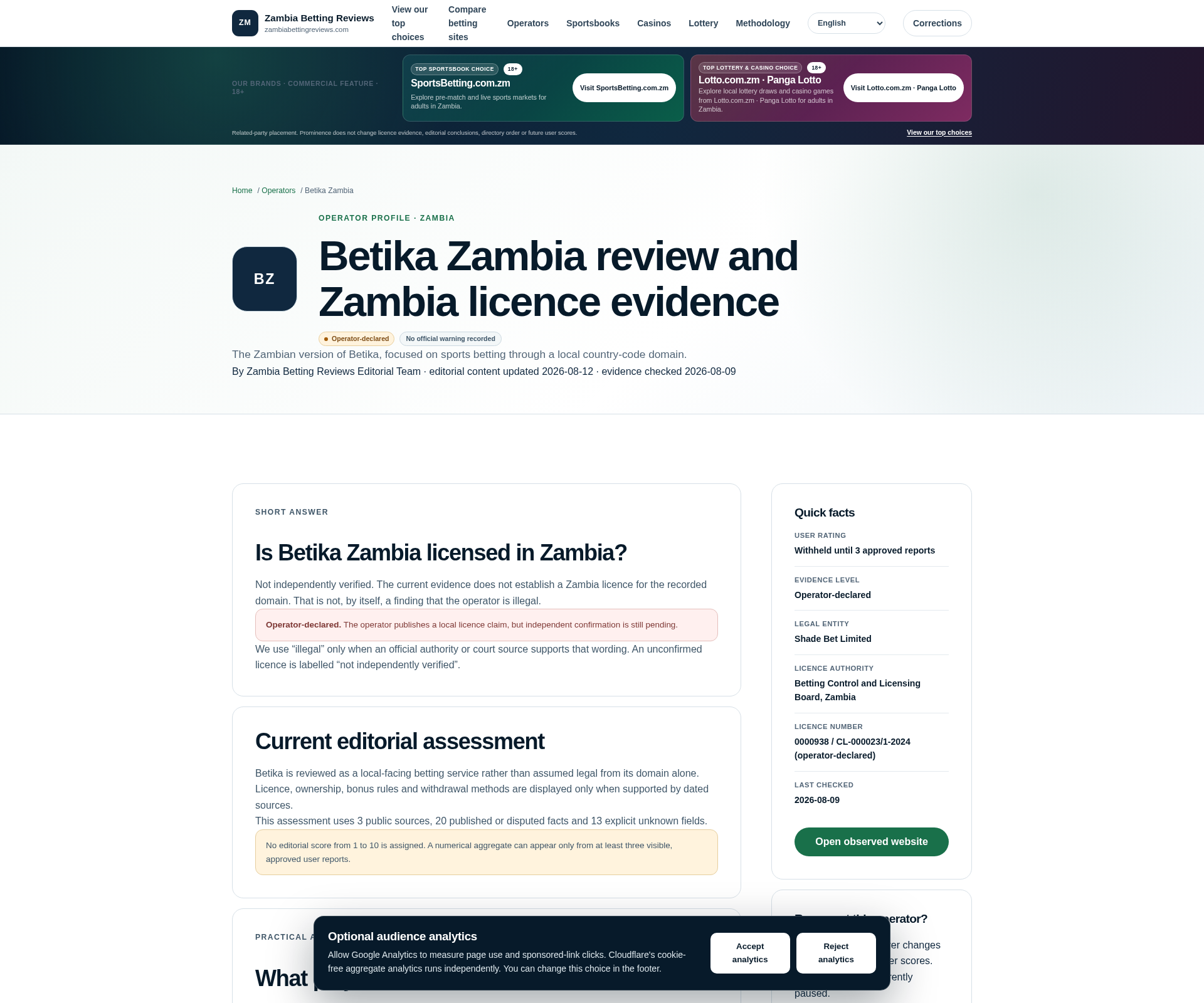
A dated third-party listing was supplied as discovery context. It is not a regulator record and cannot authenticate a website. Do not use its statements as a substitute for a current government match. When two addresses compete for trust, the correct response is not to choose the more attractive one; it is to withhold credentials and payment until authoritative confirmation is available.
Evidence chronology and assessment method
All four ledger entries were checked on 22 August 2026. The government agency page establishes institutional context. The Act supplies the statutory framework. The casino-guidance page supplies application context but no current operator-domain register. The third-party capture is contextual only.
| Date checked | Record | Role in the assessment |
|---|---|---|
| 22 August 2026 | Ministry agency listing | Primary evidence of relevant listed control bodies |
| 22 August 2026 | Betting Control Act | Primary evidence of the Board and bookmaker licensing framework |
| 22 August 2026 | Casino-licensing guidance | Primary procedural context, not a domain register |
| 22 August 2026 | Third-party operator listing | Discovery context only; no proof of licensing or safety |
The method gives priority to current primary evidence and requires the precise domain and entity to align before a green signal is used. Operator declarations are recorded as claims rather than converted into regulator findings. Third-party material may identify questions but does not decide legality or complaint truth. A red signal requires an official adverse record or corroborated documented evidence; neither is present.
The result is amber because decisive evidence remains open. The assessment can change if a dated competent record confirms or rejects the relationship among Shade Bet Limited, the quoted licence and a precise domain. Full criteria are available under methodology and editorial policy.
Compare options only after independently confirming the destination and accepting the unresolved evidence limits.
Unknowns, corrections and what would change the signal
The exact domain, licence expiry, current licence status, payment methods, withdrawal performance, identity-check rules and complaint outcome are unknown. No personal betting, deposit or withdrawal experience is claimed. No supplied record proves that the operator is unsafe, and no current primary record proves the full licence-domain match.
A green reassessment would require current primary evidence naming the legal entity and licence while tying them to the exact domain being assessed. A red reassessment would require an official adverse finding or sufficiently corroborated documented evidence. A new operator statement alone would not close the primary-evidence gap.
Corrections should identify the disputed sentence and provide a dated record, complete domain, issuing body and verifiable context. Do not send passwords, one-time codes, unredacted payment credentials or unnecessary identity documents. Use the contact route for corrections. Submissions are evaluated against the same evidence hierarchy rather than accepted because they favour or criticise the operator.
Frequently asked questions
Is Betika confirmed as licensed for a specific Zambian domain?
No. The supplied declaration names Shade Bet Limited and licence 0000938 / CL-000023/1-2024, but the accepted primary records do not connect those details to an exact domain or confirm current licence status.
Is Betika a scam?
The packet does not establish fraud or contain an official adverse record. It also does not provide the current domain-level evidence needed for a positive safety or legitimacy finding, so the appropriate signal is amber.
Is Betika legal in Zambia?
Zambia has a bookmaker licensing framework, but the cited records do not prove that the declared licence is current or that it covers a precise Betika domain. Legality remains unresolved for the exact online service.
Which payment methods and withdrawal times are verified?
None are verified in the supplied evidence. There is no accepted record of deposit methods, fees, limits, processing times or a completed withdrawal test.
How can I identify a cloned Betika website?
Check every character of the registrable domain, inspect redirects and payment recipients, and distrust unsolicited sign-in links or requests for one-time codes. A logo, padlock or copied licence number does not prove ownership.
What should I do after paying a suspicious recipient?
Preserve the domain, messages and transaction details; contact the payment provider immediately; secure reused credentials; and submit a written complaint through an independently verified channel. Do not pay an additional release or recovery fee.